
Don’t hit the snooze on this alarm
2012 February 18 by leadingedgestrategies
When an alarm system is broken, you fix it, you don’t turn off the alarm. But that’s what Congressman Mike Rogers-R (Alabama) who is also the chairman of the Transportation Security Subcommittee Congressman said in a recent Bloomberg article – he believes that the terrorist threat has changed and that we should look at getting rid of the air marshal program. Was George Bernard Shaw right? Do we truly learn nothing from history?
Let’s say your house gets robbed, so you buy an alarm system. Then, you don’t get robbed again for 10 years. Should you conclude that the threat is now gone and you should get rid of the system? No, most people would logically conclude that the alarm system is what’s keeping the house from being robbed again. Then, take it a step further and post a sign in front of your house stating that the system is now inactive. How ludicrous would that be? But, it’s apparently what is now being considered.
The air marshals have had some problems recently. The solution should be to fix the problems, not get rid of this essential layer of aviation security. Air marshals were among the first responses to hijackings to ever be employed (JFK deployed them back in the early 1960s to deter hijackings). Throughout history, as we’ve applied additional security measures, the air marshal program has come and gone and come and gone – and every time it goes away we pay the price. In fact, nearly 3,000 people paid the price on 9/11 when we decided back in the 80s, that the hijacking threat was essentially gone and we should just focus on bombs.
While you cannot point to defeated terrorist attacks or hijacks attempts as a result of the air marshals, I can almost guarantee without them, the terrorists will have renewed resolve that they can once again use hijackings as a weapon in their arsenal.
What are we thinking? Is the thought that passengers will suddenly rise up against an attempted hijacking – against knife-wielding bad guys, maybe, but it’s short-sighted to think that the next hijacking will look like the last one. It will probably not. In fact, the next hijacking may have hijackers with pistols, IED’s and submachine guns that have been smuggled on board by airline or catering employees – it’s a tactic that’s been used frequently in the past and why should the terrorists not return to what’s worked for them in the past? Do we really want to bring guts and skin to a gunfight, and also tell the bad guys that there is NO chance an air marshal will be on board?
Air marshals should be here to stay. They are part of an integrated, layered security system – and if there aren’t any attempted hijackings on their watch, then maybe they are doing their job. Take them away, and I can almost guarantee the bad guys will break out the old blueprints and start planning the next 9/11. This is one alarm system we don’t want to hit the snooze on.
http://www.businessweek.com/news/2012-02-17/air-marshals-cost-effectiveness-questioned-by-u-s-house.html
Ideology Dies Hard, maybe we need Bruce Willis
2011 November 23 by leadingedgestrategies
Ever notice in all the Die Hard movies that once the bad guys are dead, they stay dead? They don’t continue to inspire hundreds if not thousands of others? Too bad movies don’t imitate real life.
For the past few years, YouTube has been the place for those really upset with society to get their terrorist freak on. Fortunately, the propaganda machine was hit with the heavy sledge hammer on the day that YouTube Star and Chief Motivational Officer (CMO?) for al-Qaeda, Anwar al-Awlaki, and Inspire magazine editor Samir Khan had Hellfire missile for breakfast. But I guess there are a few previously inspired nutjobs still out there.
The recent arrest of Jose Pimentel, suspected of plotting terrorist attacks in the U.S. demonstrates the power of the spoken word and the threat posed by those who not only inspire violence, but provide information on how to carry out such attacks. This model is not without precedent – it is well known now that Timothy McVeigh was inspired by the Turner Diaries, to carry out his attack on Murrah Building. Now, being a writer, I’m the last one to dress down our 1st amendment right to free speech, but every writer should realize that what you write, sometimes has power and influence. I guess if you’re going to yell fire in a crowded theater, when there’s no fire, don’t be surprised when someone pops you one. Remember Salman Rushdie?
The power of the Lone Wolf nor the propaganda ministers, should not be ignored. While large scale attacks, such as the Mumbai active shooter assaults, the train bombings in Madrid and the subway and bus bombings in London, along with 9/11, are devastating, hundreds have been killed by a lone wolf. The downing of PSA Flight 1771 in 1987 was by a distraught airline employee as just one for instance. The bombings of numerous aircraft throughout aviation’s history were carried out by a single person.
The Lone Wolf attacks seem to be ramping up. It’s apparently getting harder for the bad guys to put together a large-scale attack, but consider if Umar Farouk Abdulmutallab, the so-called “underwear bomber,” or Faisal Shahzad, who attempted to detonate a car bomb in Times Square, had been successful. Hundreds would have perished, and the response from Congress and Homeland Security would have cost billions more to the U.S. economy and eroded more of our personal freedoms and way of life.
While we have been worried about the large scale attacks, we should not lose focus on the Lone Wolf. The Lone Wolf is harder to detect – he or she lives among us and moves throughout our society with less suspicion. Operational security is easier to maintain when the Lone Wolf keeps his mouth shut, as compared to 19 people, their handlers and trainers, and support personnel, trying to keep their mouths shut. The Lone Wolf, when properly motivated, carries out his or her mission, rather than, as in the case of one of the 9/11 hijackers, who began to lose heart because he had a wife and child to live for. The Lone Wolf is a one-and-done operation, which are among the hardest to defeat.
What will stop the Lone Wolf? The first step is to eliminate the motivators and opportunities for training. The killing of a Anwar al-Awlaki and the editor of Inspire magazine, Samir Khan, is a victory for the good guys. Both used the power of social media to influence the masses, just as Hitler and others controlled the media in order to ensure only approved messages were sent forth. Inspire magazine provided blueprints for creating bombs and carrying out attacks. While similar “instructional” documents are available on the Internet, consider that much of what is on the Internet, isn’t accurate enough to stake your life on. Just ask any academic or researcher.
Most of the Lone Wolf attacks that have been recently thwarted have been the result of good investigative and intelligence work. This layer of aviation security cannot be underestimated. While the focus is always on the screening checkpoint, the reality is that the checkpoint is near the FINAL point of failure of the system – it’s better to stop the attack in the initial phases.
Other Lone Wolf preventative measures include, as I’ve always encouraged, good workplace violence training and being aware of your surroundings and the people you come into contact with. Lone Wolves exhibit signs far ahead of time, that they are disenfranchised – not like everyone else in the U.S. workforce, but enough to take violent action. While we all may despise working for “the Man,” there are those who have decided that their lot in life is really someone else’s fault, and they find inspiration and instruction on YouTube and in the pages of terrorist publications.
While the recent deaths of bin Laden, al-Awlaki and their ilk, have struck a blow for justice, there always seems to be someone coming along to take their place. Their influence has extended beyond their years here among the living, and continue to inspire others. There will be others. There will always be others. It’s not time to let the guard down. Bruce Willis’ enemies may die hard, but ideology dies hardest.
Airport crime statistics are questionable
2011 July 26 by leadingedgestrategies
USAToday (click for the story) reported that crime outside of airports is higher than other areas of many cities. However, I take issue with the listing that Denver International Airport received. Check out the list here.
Denver International Airport received a ranking of 421, beating out San Diego and Los Angeles International Airport. I’ve spent time training employees at both airports, SAN and LAX, and helped open DEN when I worked there. I’ve stayed at the hotels right out the front gate of LAX, which is right down the street from Watts and Compton, and I’m befuddled that Denver gets a higher crime ranking.
Apparently, this was a computer generated statistic, without reality involved in the equation. I would like to know what high crime area around Denver International Airport was surveyed. First, the airport sits on the plains, surrounded by miles and miles of miles. The nearest subdivisions are a good 15 minute drive from the airport and the hotel area, a 10 minute drive from the airport, is not a high crime area. There is a high crime area, but it’s about 15 minutes west of the airport, and your normal airport traveler wouldn’t be wandering off into that area.
Now, let’s compare this to LAX – which, by it’s location is a higher crime area. I’ve taken frequent walks from my hotel, which is usually the Courtyard Marriott, right at the big L-A-X letters at the airport entrance, to the 24hr Fitness center, about 3 blocks away, and I’ve walked even farther east to some of the eating establishments. I’m personally on high alert during these walks, particularly at night because it is a high crime area. However, I’d walk from DIA, all the day to Interstate 70, which is a 9 mile hike, and the only violence I’d be worried about is getting hit by a speeding car on Pena Boulevard.
Please take lists like this with a huge dose of salt. I’ve personally been to every airport on the list and in some cases, like Philadelphia, there’s probably some good justification there. But in many of these cases, it seems the compute has taken a nearby subdivision, that no traveler would ever go to unless they are lost and used its statistics to prove their point, erroneously.
Implants and Bombs
2011 July 7 by les-admin
The latest threat to aviation security now appears to be bombs that are implanted or inserted inside the bomber. Whose to say the next buxom blonde at the checkpoint, isn’t packing bosoms that go boom? Well, let’s look at a few key points. Click here for the story.
Concealing items inside the body is not a new concept. Ask any customs agent or prison guard and either can explain the many ways the human body can be used as a hiding place for contraband. But as an explosive? Well, there was the incident in Saudi Arabia in August 2009, where a suicide bomber infiltrated security and detonated a bomb inserted in his rectum near a Saudi prince. The prince escaped with minor injuries. So, the concept is possible.
TSA has issued travel alerts that we can expect more scrutiny at checkpoints as a result of this threat, even though there is no specific threat (that they are telling us about) at the present. One perspective we do have to look at then, is the possibility that this is no more than al Qaeda propaganda sent our way intentionally to get us to overreact. Remember the printer cartridge plot out of Yemen? That cost al Qaeda about $4,000, meanwhile, we’ve spent billions trying to prevent that type of attack from happening. Not a bad return on your investment when part of your goal is to destabilize the U.S. economy (like we need help doing that – do these guys get C-Span?).
Is this just rumor, designed to get us to panic, be afraid and spend more money? There is also the question about whether the explosive, concealed inside implants, or the body, could be large enough to destroy an aircraft. Some experts feel it’s not possible, others disagree. I guess we need Mythbusters to help us out here.
But let’s assume that it is possible and that enough explosives could be concealed to bring down a plane. Will existing technology, i.e. body imagers, protect us? Yes, in some cases, body imagers can detect items inside an individual – it just depends on the machine. The body imagers come from our prison industry where they were designed to detect items concealed in the body. Also, explosive trace detection systems can be effective at determining if an individual has been handling or exposed to dangerous explosives. While it’s possible, it’s also very difficult to completely clean yourself of residue once handled. K-9 teams, in certain cases, can also detect explosives hidden within or residue left on the body.
There is another consideration. How will the device be detonated if it’s implanted? Will the detonating charge and mechanisms also be implanted? Sounds like some major surgery to me. We have to look at some basic facts. Terrorists and bad guys, who want to be successful, try to keep is simple. The more complex the attack, the more people get involved, the easier it is for things to break down and for someone to talk. There were several additional elements of the 9/11 plot that were left on the drawing table because the chance for failure was increasing with the complexity. Cargo planes were supposed to be targeted on 9/11 and at one point, Atta was pitched the idea of crashing into a nuclear facility instead of the World Trade Centers. Additional aircraft were also rumored to be hijacked on that day.
But back to the subject at hand.
I’m not as worried about implants as much as I would be concerned about a plot similar to the Saudi attack. Much easier to get someone to conceal an item in their rectum (although incredibly uncomfortable I would imagine) and attach a detonator, than to go through a highly complicated process of implanting a device.
But this leaves us with our fundamental security question: how safe do you want to be? If we start digging around in your body, are you ready to set aside your Fourth Amendment right not to be subjected to unreasonable search? Many people are – these are the “security at any costs” types who buy into the illusion that the government can prevent every bad thing from happening to them. Even after the pat-down of a 6-year-old and the diaper-gate nanny incident recently, there are still those that believe that everyone is a suspect and that no one should be exempt from scrutiny.
As General Robert E. Lee is credited with saying: “You cannot defend everything and by doing so, you will end up defending nothing.”
Maybe we need to look at this from a different perspective. Rather than buying billions in more technology to try to prevent this “next threat,” we invest heavily in our investigate and intelligence methods and personnel and attempt to stop the implant-plot before it gets out of the safe house, rather than at the last point of failure, the screening checkpoint.
Why you should not be afraid, or even very afraid
2011 May 6 by les-admin
I was at my usual Starbucks stop this morning and took my usual stroll through the connected Barnes & Noble to buy a magazine, when the clerk said she saw me on TV the other day, talking about the bin Laden raid. She was worried because she is going to be on a commercial flight soon and feared a counter-attack.
I asked her if she was flying domestically or international. Domestic.
I told her not to worry too much. First, there’s a slim chance statistically that she would be on a flight that has an issue, but second, because of the Navy SEAL party at bin Laden’s house last week, nothing big should be happening anytime soon. Let’s face it – al Qaeda is not stupid. The killing of their leader represents a colossal failure of intelligence on their part. Plus, the fact that the U.S. now possesses a lot of bin Laden’s planning materials will make the rest of al Qaeda sit back and get paranoid. Any major event they had in the works may already be compromised.
Al Qaeda will need to assess its own intel failures, its operational security, and try to figure out just how much we now know about their operations and their operatives.
Most terrorists don’t fear death, but they do fear giving their life up cheaply. They want the operation to work and they are willing to be patient. They will be looking at their safe houses, and their personnel in a whole new, and suspicious way. They won’t know who to trust or whether their own information is now being analyzed somewhere in Langley, Virginia.
International travel is a slightly different story. So is the lone gunman. Internationally, American’s will make easy targets for a low-level attack, such as a shooter, or hostage taking, or even a car bomb. These are easier hits because travel to the U.S. is not required for the bad guys. There is also the possibility that a lone gunman, living here in the U.S. either trained, recruited or just plain ticked off at life and has spent too much time on the Jihad websites, takes matters into his or her own hands and heads to a U.S. shopping mall with a weapon and an attitude. Hard to control that, but for the big ticket items, hijacking planes or sabotaging Amtrak, I think those are on hold for a little while.
Ding dong the Witch is dead
2011 May 2 by les-admin
Osama bin Laden is dead. However, despite some comments on certain media outlets, this does not end terrorism. In fact, if anything, we need to be more alert and aware than ever before. While bin Laden was the clear leader of al Qaeda, terrorism is not a new threat, and Islamic Jihad is a movement that will not stop because of a fallen leader.
Being a veteran of sorts of the drug wars of the late 80s and early 90s, I remember when Pablo Escobar was killed. While Escobar was a kingpin in drug trafficking, and his death was a victory for the good guys, others would take over his supply lines, routes and customers. Drug operations run like terrorist cells, characterized by small operations, consisting of individuals who operate largely independently. They come together, do an operation and then vanish. You can kill a cartel leader, but the trafficking goes on. Others will take their place, some more effective, some less. But it will go on.
What should we expect at this point? First, it would not surprise me to see some low level attacks, lone gunman type situations of followers of bin Laden who are now either leaderless, or let their emotions get the best of them and head to the streets with a gun or bomb. Second, there are plenty of other leaders within al Qaeda out there – particularly in the Yemen area. With bin Laden’s operations severely limited due to the entire world hunting for him, other cells of al Qaeda have ramped up their operations.
Also, remember that Ramzi Yousef, the mastermind of both the first bombing of the World Trade Center, and Operation Bojinka, a multi-level plot that included blowing up 12 U.S. airliners over the Pacific using liquid-based explosives, and the arrest of Khalid Sheik Mohammed, Yousef’s uncle and the mastermind of 9/11, did not stop the al Qaeda engine. This is a 100 years war (probably longer) and the killing of bin Laden, while a necessary response, and a victory on our side, the threat is not going to go away. If anything, the threat will increase as some al Qaeda personnel will “go to ground” (lay low) and may start working more intelligently on either multiple small scale or large-scale attacks.
But for tonight, it’s okay to celebrate. This is a victory. I believe that to a certain extent tonight, maybe some of the victims of 9/11 have been vindicated.
Assault at Denver International Airport
2011 April 15 by les-admin
I used to work as the assistant security director at Denver International Airport. When I saw the story about the recent sexual assault that took place int the terminal building it reminded me, as it should remind every aviation security practitioner and passenger and employee, that aviation security is not just about preventing terrorism, it’s also about preventing common crimes such as assault, drug smuggling, theft and human trafficking.
Large airports are small cities with daily transient populations of 40,000 to 50,000 or more, and employee populations of ten to twenty thousand and up. With that many people, you’re going to have a few that are less then honest.
While theft is the most common airport crime, and assaults are admittedly the least, the question remains, what should or can be done to prevent it? It certainly is a heinous crime. In the case in Denver, airline employees saw what was happening, intervened and summoned both security and police assistance. Word is coming out now that the assault may have been caught on CCTV, however, CCTV is not always an effective method of catching someone in the act of committing a crime, unless someone is watching every camera.
The problem with CCTV is that it’s great at evidence after-the-fact, and has some benefit as a deterrence if the bad guy knows he’s on candid camera, but it’s not very good at catching the act while it’s happening. The problem is, with thousands of cameras at the airport, there are only a few actual monitors and even fewer people watching them. Also, it’s impractical to sit and stare at a monitor all day as humans make terrible system monitors – just ask the FAA guys dozing off in the towers.
Will more CCTV cameras deter this type of crime? The additional question is, will more CCTV monitors provide a better cost/benefit to the airport based on the frequency of the occurrence of this type of crime and, are there more effective methods of preventing, deterring and responding to assaults in the airport. In other words, are there better places to spend money and resources to prevent assaults than buying more cameras?
The chances that an individual monitoring a series of cameras is going to catch a bad guy in the act, considering this type of assault is incredibly rare, is incredibly small.
Many of DIA’s badge holding personnel, whether they work for the airport, the airline, or wherever, if they hold an Airport ID Badge, they’ve been provided with both training in identifying suspicious activities and training in how to notify the airport police in case of an emergency. From early reports, it sounds like some employees may have ignored the woman’s initial cries for help, and it wasn’t until two Frontier Airline ramp workers observed the scene from outside and ran to help, that the assault was stopped and reported. If that’s the case, the individuals who ignored the woman’s pleas, need to be re-trained. And the Frontier employees need a free trip to Disney World for stepping up.
Even though community policing is the strategy for good airport policing, crime still does occur at airports and it’s not always employee theft from baggage and cargo (the most common crimes), nor is it always drug smuggling. Human trafficking, sexual assaults and simple assault, also takes place at U.S. airports – the former more often than many would like to admit.
Perhaps a few more cameras couldn’t hurt – but maybe airports should take a lesson from school security experts and install panic alarms, or train airport and airline workers that in an emergency, if they cannot get to a phone, to activate one of the thousands of door alarms throughout the airport, which will usually get a security or police response rather quickly.
It’s time to issue a BOLO (be on the lookout) to airport police, security guards and operations personnel, and all airport / airline employees for real crime taking place, not just terrorism.
Counterterrorism, Whack a Mole & the industry’s soft underbelly
2011 March 3 by leadingedgestrategies
A British Airways employee was just convicted of plotting to blow up an airplane (click here). He had also been told by his handlers to find out if they could get a bomb or a person with a bomb on board a flight. Fortunately, Rajib Karim was only a computer tech – he had applied for but been rejected for a flight attendant’s position, which would have given him much easier access to the plane.
Just one day after Karim’s conviction, an airport worker with possible al Qaeda ties fired on a bus of American serviceman, killing two and wounding several others.
Unfortunately, this was all predictable, but the solution to the problem is far more complex.
Some will call for screening of employees, just like passengers go through. Employee screening has been a topic of debate in the aviation industry for over 20 years, but would this have solved the problem in either case, or will it prevent future such attacks?
When the Moscow bombing happened, there was talk of relocating the screening checkpoints farther out, into the terminal entry points. But, unless you spread those checkpoints out, like they do at Dallas/Ft. Worth, you have only relocated the site of the next attack – active shooters and bombers want to blow up areas where there are lots of people. Most U.S. airports are not configured like DFW so you’re talking about millions of dollars in terminal re-design if you go this way.
If you want to know where lots of people congregate in an airport, just ask Homeland Security Secretary Janet Napolitano, who today issued a statement saying that budget cuts will result in longer screening lines.
Since 1990, legislation has called for the “screening” of employees. Since 1990, the industry has defined “screening of employees” as some sort of background check. Some things have changed over time, and you will routinely see employees going through the security checkpoint, but the majority of employees at an airport legally bypass the screening areas every day. When you ask if employees are “screened,” the answer is yes – through the criminal history record check and the security threat assessment conducted on all airport and airline workers. But, most have not walked through a magnetometer before being allowed to access your plane.
It’s also not as simple as making everyone go through the existing passenger checkpoints. At some airports, you will put 10x the number of people through those checkpoints than currently go through, when you add employees to the mix.
To implement actual employee screening for all airport and airline workers runs into a gamut of challenges. First, is the infrastructure costs to redesign terminal areas to accommodate the screening equipment, then there is the additional cost of the screening equipment. Now factor in personnel costs to hire and train thousands of screeners. At the airports that do 100% actual employee screening, such as Miami and Orlando, there were opportunities during construction projects to do the necessary design changes. Their screener workforce are not TSA employees, they are private screening companies paid for by the airport operator through airport fees and revenue.
Some additional logistical challenges also arise when you decide to screen employees. What about aircraft mechanics that require tools that are on the prohibited items list? What about first responders, such as airport operations and maintenance personnel, paramedics, plus dozens of other airport and airline personnel who either must respond to an emergency, or must take quick action to avoid delays or other problems? One solution is to identify those individuals who are allowed to bypass the checkpoints, conduct higher levels of background checks and add biometric identification to airport access control systems.
BUT – what is to prevent the trusted employee from going bad, or from a bad guy becoming a trusted employee? This is not a new problem, just an old problem with a new set of consequences.
It’s well known that bad guys will put themselves into positions where it’s easier to commit their crimes. If you’re a burglar, you may try to find work as a locksmith, or contractor who has access to houses on a routine basis, or maybe even with an alarm system company. A standard mode of operation for a pedophile is to try to get a job where they have easy access to children, such as in schools or daycares. Just recently, a TSA behavior detection officer was arrested for drug smuggling (click here), and not too long ago two air marshals were arrested for drug and weapons smuggling. An airline worker was also recently arrested on charges of facilitating human trafficking.
Throughout the history of aviation some of the most significant attacks have been carried out by employees within the system, or assisted by employees. In some cases, attacks were carried out by individuals pretending to be employees. This is clearly the soft underbelly of aviation security.
What’s the solution when the trusted person, violates that trust, and the consequences are not smuggled drugs or weapons, but bombs on airplanes?
The solution is to follow the lead of those in the child care industry, but take it a step further. As a simple Sunday school teacher, I underwent a background check and was required to do training to know what was appropriate and inappropriate behavior, and to be able to spot inappropriate behaviors in others. I have to re-certify by going through the training every year. Does this process stop every single individual? No, but it stops a lot more than it used to by not doing training and background checks.
I agree that many airport and airline employees should be physically screened, but there are whole categories that should not. Trusted employees need to be (a) given a higher level of background check, beyond just fingerprints, wants and warrants, and (b) training on how to spot unusual and dangerous behavior – just like the workplace violence training programs.
Presently, the background checks required by the federal government are still not strong enough. They are far better than they were, but many local airports conduct higher levels of background checks because of the gaps in the federal process. Employees that are “trusted” such as airport police, operations and maintenance personnel, certain airline personnel, pilots and flight attendants, should undergo very thorough background checks, looking at past-history of associations and links to potential bad guys or bad organizations. I know this sounds a bit heavy but we’re allowing you unfettered access to the airport and aircraft in trade. If you’ve got nothing to hide, you’ve got nothing to worry about. If you don’t want that level of check, go through the checkpoint.
Additionally, all employees that receive an airport identification badge or airline ID badge should be trained in the basics of identifying workplace violence indicators, and suspicious activity. They should re-certify every year.
The good news is that since 9/11, we’ve caught a lot of bad guys and shut down a lot of operations. Perhaps terrorists aren’t as smart as they used to be because so many have been caught that al Qaeda is now recruiting a few notches down on the intellect ladder – notice how the last few terrorist attacks have resulted in guys not remembering their training in how to make a bomb go off? I think that it’s a mixture of luck, and the bad guys using dumber bad guys to try to pull off attacks, because a lot of smart guys either met their demise,went into hiding or are in custody.
Aviation security is just like Whack-a-Mole. Whenever one threat is mitigated, another one pops up. The threat of employees within the system committing terrorist and criminal acts is one that pops up frequently. We need to quit hitting the mole’s head and start working on extracting it completely, through better background checks and better training, or it will pop up again, with deadly consequences.
Suicide bombing in Moscow Airport, could it happen here?
2011 January 24 by leadingedgestrategies
Updated: 2:31 pm MST:
Based on the first reports, a suicide bomber detonated an explosive in the terminal building at the Moscow Domodedovo Airport. The explosion occurred near the the international arrivals section of the airport. We are now hearing that there may have been two bombers. Click here for USAToday report. Early reports is that at least 32 have died and an additional 130 are injured. Industry security experts have warned against this type of attack for several years, and this is not the first time airport terminals have been targets.
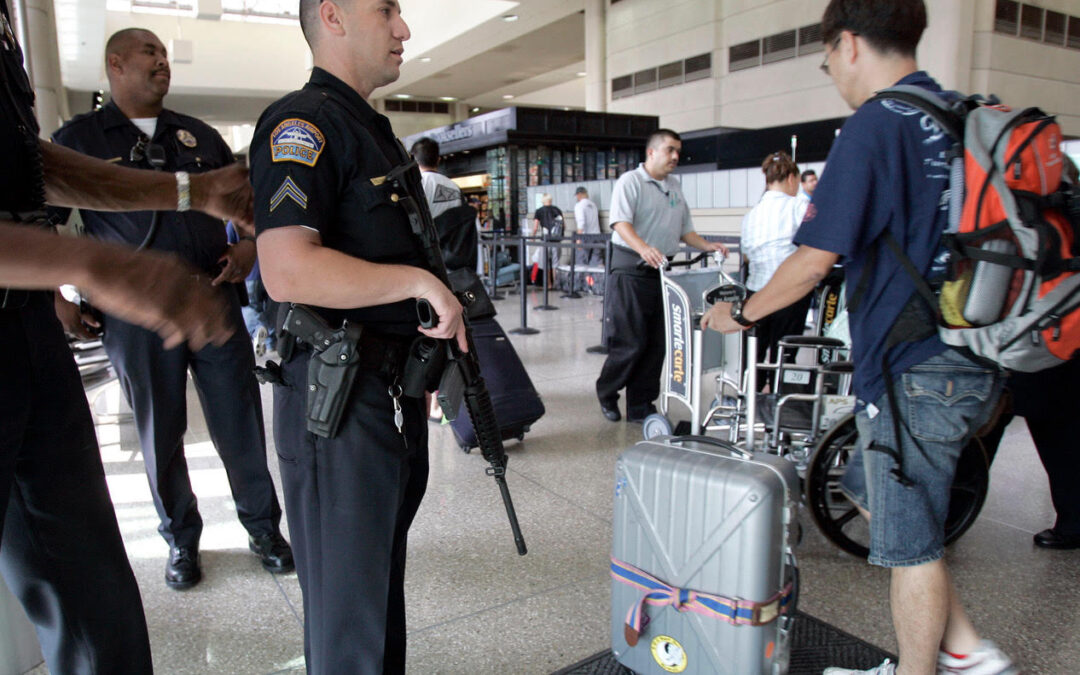
In addition to airport bombings in 1973 and 1975 at LAX and LaGuardia, respectively, in 1985 armed gunmen with assault rifles and grenades stormed the public terminal areas in the Rome and Vienna Airports, in an active shooter attack. To this day in Rome’s Leonardo daVinci Airport, heavily armed and armored police officers with automatic weapons patrol the terminal areas on catwalks, protected by bulletproof glass and hard points. U.S. airports, and many other airports throughout the U.S. are not as well prepared.
Some will say that the defense against a suicide bomber in the terminal building is to move the screening checkpoints into the ticketing areas, or even at the front door of the terminal, however, this only relocates the same threat, it doesn’t mitigate or deter it. Others will say that a suicide bomber cannot be stopped. They are also wrong.
So, how do we stop this threat?
The easiest way is to stop the threat in the planning stages. No one just wakes up in the morning, builds a bomb and heads to the airport. There are bomb makers involved, individuals who must acquire bomb making materials, surveillance personnel, drivers, safe house operatives, and handlers all involved in the operation. What seems to be a random event is actually a carefully planned operation that CAN be detected ahead of time. Good behavior detection and suspicious awareness training can help detect when an operation is in the planning stages, such as detecting pre-incident surveillance.
What if that fails?
Israel has developed personal defense training for their police officers, which includes taking down a suicide bomber. This is not to say it isn’t VERY dangerous but consider that the alternative is to likely die in the blast anyway, it’s best to have some skills to try to keep that from happening. Immediate, armed intervention can stop an active shooter event, and police officers who are alert and aware of what is happening in the terminal building can deter or rapidly respond to a suicide bomber threat. However, most U.S. police officers are not trained on how to take on a suicide bomber. They need to be, particularly at our nation’s airports.
The last line of defense, is response. When the event has happened, the best thing to do is to rapidly respond to the event and get the airport back up and running. While the loss of life is always tragic, it’s also important to remember the real motive for the attack, which is to cripple economies, change the way of life for the nation’s citizens, eat away our personal rights and privacy’s, and ultimately change our country for the worse. The quicker we can bounce back, the more resilient we are against these threats.
A key line of defense is deterrence. An alert, well-trained, well-equipped police force patrolling the public areas of a terminal building, like they do in Rome, can be a huge deterrent to a suicide bomber. Suicide bombers fear only one thing more than death, and that is failure. They don’t want to get caught before they’ve had a chance to press the trigger. When conducting surveillance, an airport whose police and security personnel are alert, well-equipped with modern radios and weapons, and who are watching over the public areas closely, will be a huge deterrent to the bad guys planning to do harm. They’d rather find a terminal building where the cops have Retired On Active Duty, are rarely seen and when seen, are not in shape, nor alert and are carrying an aging revolver that hasn’t seen the outside of the holster in five years. If you’re the bad guy, which airport are you heading to?
If rapid response is our last line of defense, what is our first? Fortunately, there are a few. First, there is intelligence gathering and human operatives in the field from the CIA, FBI, DOD, foreign governments friendly to the U.S., and other agencies. The Yemen air cargo printer bombs were discovered by Saudi intelligence and the London liquid bomb plot in 2006 was also discovered by intel operatives, in Great Britain, before the operation had a chance to move forward. Next, there is border security. While some attackers may already be U.S. citizens, it is likely that they have traveled at some point in time outside of the U.S., which means there should be a record of their departure and arrival. While it may not seem that difficult, it actually can be hard getting into the U.S. You can talk to me about the porous border between Mexico and the U.S. but with UAV’s, agents on horseback and plenty of other personnel and technology, not just anyone can wander over. Plus, if you’ve been out of the country getting terrorist training, the last thing you want to do is to get caught coming back into the country, which means you may use false travel documents if flying commercially, or you may engage the services of a guide to smuggle you back into the U.S., both options mean that even more people are now part of your plot.
Once back in the U.S. a bomber must be equipped and most suicide bombers are not bomb makers. It can be hard to find recruits to be suicide bombers as well, as you have to find someone willing to die for the cause. It’s harder to do that than it is to find someone willing to kill for the cause. Suicide bombers will have handlers that keep them separate from family and friends (i.e. any reasons to live), and continue to coach them from training, waiting and right to their target site. In some cases, the handler may even have a device where he or she can remote/command detonate the suicide bomber’s device just in case the bomber is interfered with or loses their will to carry out the mission.
Another point is that suicide bombings can happen anywhere, what makes an airport so special? The fact is that when you bomb an airport, you shut down commerce for that immediate area, you disrupt commerce throughout the world for a period of time, and eventually, with aviation security such a hot button topic, the bad guys know that we will spend billions trying to prevent that type of attack from happening again. Where will that money come from? A key goal of terrorism is to make a country suffer economically, bankrupt it if possible. Currently, the national debt is $14 Trillion dollars – where will the billions or even trillions more come from to prevent the next type of attack?
Should we be worried about a similar situation taking place here in the US? It is a concern but there are things we can do to prevent it from happening and we should start looking at that now, rather than waiting until it does happen. Without spending billions in technology, we can instead spend millions in training – training of airport personnel in suspicious awareness, training of police officers in suicide bomber takedowns, and training of police officers in active shooter response – some semi-automatic weapons like the ones the Boston/Logan police carry around would be a wise investment as well.
The last major aviation security incident in Russia was in 2004 when two female Chechan suicide bombers bribed airline employees to obtain boarding passes for two departing flights. Over 80 were killed when both aircraft were downed by the explosives.
It’s finally gone too far
2010 November 4 by leadingedgestrategies
If you’re not aware of the ramifications of TSA’s new pat-down policy, click here. If the link is still active, what you likely saw was a TSA screener appearing to conduct a pat down search of a a small boy. Yea, I know it looks like he’s feeling him up, but according to our government this is a necessary process to protect the flying public.
Okay, it’s now officially gone too far. I of all people understand that kids, women, the developmentally disabled, and the elderly have all been used to smuggle bombs, carry bombs, or other criminal or terrorist purposes, but there is a much BETTER way to do this. There is a process we can use that with one look, would have told the screener that that particular kid is not a threat.
First, let’s look at the options for screening individuals, then you can determine (or weigh in if you disagree) as to what the best method(s) are.
Since the 1970s, passengers have passed through walk-thru metal detectors. We know they don’t detect explosives, so what are our other options? There are basically 6 options for screening people for explosives: (1) body imagers, (2) portal trace detectors, (3) behavior detection, (4) physical pat downs, (5) electronic screening of passenger information prior to boarding – i.e. TSA’s Secure Flight but at a much higher level, and (6) thorough background checks on passengers.
Keep in mind that privacy rights groups have issues with ALL of these methods. Sorry, can’t make everyone happy – my goal is to not have to give up a ton of rights either, but also to make sure I can safely board a plane with my family without having my kids molested in the process. And to be fair, I’m sure most TSA screeners don’t look forward to patting down the general public anymore than we want to be patted down. I’m not pointing the finger at them (unless you touch my kid!), I’m pointing at this policy that needs serious review.
Let’s back out items 5 and 6 right now. While they can be effective, pretty much only so as a layer, not a process that you’d bet your life on.
That leaves us with body imaging, portal trace (known as the Puffers), behavior detection and pat-down.
Body imagers come with privacy issues, they are slower than walk-thru metal detectors, but they are quicker than pat-down, less physically intrusive and the imagery is viewed remotely (I’m sure you can see yourself on YouTube later though — even though we’ve been told these machines do not store images, it’s now been shown that they do — but who cares, it’s not like anyone can identify you with that fuzzy image). They are effective at detecting most threat objects including explosives, guns and knives.
Portal trace detectors were rolled out after two Chechan suicide bombers brought down 2 Russian airliners in 2004. Keep in mind this wasn’t the first time a suicide airliner bombing had occurred, but it was the first time the government really took notice. The “puffers” as they were called were slow, had a high breakdown rate and you still had to go through the metal detector because they don’t detect metal, like guns and knives. The puffers were pulled out of airports due to their breakdown rate and to make room for the deployment of the body imagers.
Pat-down: the most intrusive, embarrassing process you can subject the individual too. Not only passengers, but airline and airport employees must go through this with even more frequency. It takes longer than any of the other processes and comes with all sorts of bad implications. I’m sure some child molester, after seeing the LA times photo, ran to find the nearest TSA application.
Behavior detection: non-intrusive, highly effective when done properly, takes the smallest amount of time of all of the processes. The problems here go back to the old “profiling” argument – that people are being selected based on race or nationality. This argument is as old as law enforcement itself. The other challenge here is a GAO report released earlier this year that showed that TSA’s BDO’s failed to spot potential terrorists that passed through U.S. airports. TSA points to the fact that many people have been arrested based on BDO detection, but for outstanding warrants, illegal immigrant status, or something other than terrorism.
The debate rages on as to whether this process is effective but I wholeheartedly believe in it. Here’s why: The Israeli’s relied on it so heavily that for a period of time they relied more on their security questioning/behavior process than physical screening equipment. The U.K. has adopted a similar model and is already reporting successes. This type of process is also what stopped an individual from blowing up an El Al flight departing Heathrow in 1986, whereas tons of stuff gets through technology based checkpoints every day.
So what are we doing wrong here and how can we implement something that works and keeps screeners from feeling us up at the checkpoints?
First, some reality with respect to the GAO report. Maybe the bad guys who came through U.S. airports didn’t encounter any BDO’s. With some 800,000 million passengers going through U.S. airports and only about 3,000 BDO’s it’s possible that they just missed each other. Or, maybe the bad guys had no ill intent that day they were at the airport, and thus exhibited no signs. Remember, it’s very difficult to measure something like deterrence — it’s difficult to know if a deterrent measure resulted in the bad guys saying “we don’t want to go that way because of . . .” Unfortunately, the bad guys don’t often call us and let us know when some measure we’ve implemented actually deterred them.
Second, we have to look at why these programs are successful everywhere else but here. The science of this is dubious and to being a researcher myself, I agree…to some extent. I think body language psychology is more art than science. Ever watch the TV poker tournaments? The entire process is based on two things, knowledge of statistics (playing the game well) and “reading” your opponent. When science is having problems proving things, I fall back to the old adage and ask, does it work anyway? If it works, then there must be something to it, and we just haven’t figured out the science behind it yet. However, there has been recent movements towards using technology to detect deception. Again, the old argument that we will be “saved” by technology, but just remember that the studies on the effectiveness of technology is often conducted by the companies interested in selling the technology.
Third, when I talk about the use of behavior detection, I’m not talking about the exclusive use of that strategy. Initial passenger screening should begin with the booking of the ticket — do a name check. If they’re a bad guy, arrest them, if they are a suspect, give them additional scrutiny when they get to the airport. At the airport, behavior detection should take over in the form of officers at the queue lines, talking to passengers. This process will have to be refined because there is a big gap between what a BDO suspects and what a cop can do about it. Plus, it seems the training can be better — let’s analyze what others are doing and see where we’ve potentially watered down the process here.
Then, individuals who either through their travel documentation or behavior that exhibit warning signs, should be given secondary screening, to include explosive trace detection, body imaging, or if they do not want to be “imaged” then private pat down screening.
Using this process effectively, we’ll start focusing on the bad guys and quit molesting kids at the checkpoint, in the “name” of security.